Year
1978



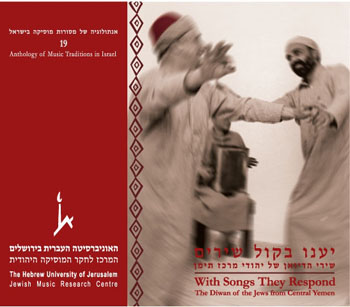

Menahem Arussi and the Kiryat Ono men and children's ensemble
Baruch Yefet
Girdle poem by Se'adia ben Amram, signed with the author's full name. Written in Hebrew, apart from the third and fourth stanzas, which are in Arabic. It is an appeal to the soul to turn away from evil desires, an allegorical poem in the form of a dialogue between the poet and his beloved. The moral and national symbolism gradually becomes apparent.
The song was well known in the Jewish community of Palestine before 1948 outside the Yemenite community, and some of its stanzas, set to various melodies, have become part of the modern Israeli Hebrew repertoire as separate songs. This applies particulary to the first, fifth and sixth stanzas. Israeli composers Mordecai Seter, Shelomo Yaffe, Ovadia Tuvia, Jacob Hollander, and Eva Pitlik have arranged this song for choir. Sarah Levi-Tanai used it in her dramatic piece Eshet hail (a woman of valour) that was performed by the Inbal dance company in 1956, and Mordecai Seter in his "Yemenite Suite" (Bahat, 1995: 216). Here only the recorded stanzas are printed (complete version- Seri-Tobi; Halevi: 527). This song is another example of the gradual abandonment of the Arabic section of the poem and the transition to the use of the Hebrew stanzas alone.
Saperi tama is sung to many melodies. In the two versions recorded here six of these are sung, Menahem Arussi and his ensemble sing one stanza in Arabic, and Baruch Yefet sings a selection of Hebrew stanzas.
9. Menahem Arussi and the Kiryat Ono men and children's ensemble sing stanzas 1, 2, 3, 5, 6, 7 and 11 with drum accompaniment; only stanza 3 is sung in Arabic. The stanzas are sung to four different melodies. The soloist chooses the melodies, and one melody is succeeded by another for the sake of variety. The four melodies are matched to the different stanzas in the following manner: stanzas 1,2- first melody; stanza 3 - second melody; stanza 5-third melody; stanza 6 - fourth melody. In the seventh stanza the third melody is repeated; in the final stanza (11) the fourth melody is repeated. The ensemble's response begins with the closing hemistich of the second verse, and is sung as a response throughout the song: the soloist sings the opening and the ensemble the closing hemistich.
10. Baruch Yefet sings stanzas 1, 2, 5, 6, 7, 8, and 9 to three melodies: the basic scheme of the opening melody is identical with that of Arussi's, and Yefet sings the first two stanzas to this melody; in the second stanza, however, he quickens the tempo and adds a drum accompaniment. The first two stanzas are sung again, the first stanza to another melody and the second to yet another. Stanza 5 is sung to the second melody, and stanza 6 to the third. Stanza 7 is sung to the second and third melodies, stanza 8 to the second, and stanza 9 to the second and third.