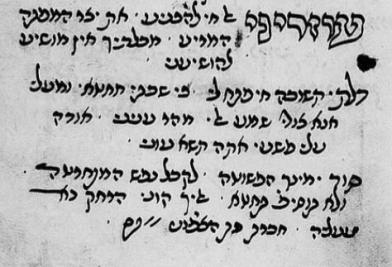
Ya salen todos los bilbiles a cantar
Salió el mas grande de ellos a bailar
Enpezaron los vergel a loar
Ay mi alma,
Luz de el alma, yo qué haré?
Cuando la mi dama sale amanecer
Los canpos de la verdura a enflo[re]cer
Todos juntos dieron loores a el Dio alto
Ay mi alm’[a]
Oro vos llamaš de cara y de nomb[re]
Q[?] porqué haceš afinar a el honb[re]
Me afinastes la mi alma sin hanbre
Ay mi alma
|
יא שאלין טודוש לוש בילביליש א קנטאר ჻
שאלייו איל מאש גיראנדי די אייוש אה באיילאר
אינפישארון לוש בירג'יל א לואר
איי מי אלמה
לוז די איל אלמה ייו קיי ארי ჻
קואנדו לא מי דאמא שאלי אמאנישיר
לוש קאנפוש די לה וירדורה אה אינפ'ולו[רי]שיר :
טודוש ג'ונטוש דיירון לואוריש אה איל דייו אלטו :
איי מי אלמ'[ה]
אורו בוש ייאמאש' די קארה אי די נומבי[רי]
ק[?] פורקי אזיש' אפ'ינאר אה איל אונבי[רי]
מי אפינאשטיש לא מי אלמה שין אנבירי
איי מי אלמה
|
The Manuscript Source
Hebrew Manuscript no. 7 of Yale University Library (hereby YHM7) is a compendium of piyyutim from the Hebrew Ottoman musical tradition. It consists of 143ff apparently binding together more than one source. The core of the manuscript (fol. 1-129) contains poems by Avtaliyon ben Mordekhai (fl. 17th century in Edirne and/or Constantinople), arranged according to seven Turkish makamlar (plural of makam, musical mode). The vast majority of the poems have a title that includes the first line/title of the Turkish or Spanish song whose melody has to be applied to the Hebrew song, the name of the makam, the usul (rhythmic cycle) and the author. At the end of each makam there are some poems by two contemporaries of Avtaliyon, Sheme”sh (Shlomo Moshe Shani) and Yaacov Amron. The second section (fol. 130 t0 end) has the running title Hadashim labqarim, an important and vast collection of Ottoman Hebrew musical poetry connected to Avtaliyon and the circle of Hebrew poets active in the Ottoman Empire in the 17th and early 18th centuries that is still in manuscripts. Fols. 136b-143b, contains poems by another contemporary of Avtaliyon, Aharon Alidi.
A small piece of paper pasted in the cover reads: “Pizmonim of Rabbi Nissim ben Shmuel may God protect and keep him alive.” The back of the cover reads: “Written by Rabbi Nissim Bekhor/Bakhar Shemuel from Salonika, may God protect and keep him alive, the rabbi of the cemetery.”
Ya salen todos los bilbiles a canṭar: Form and Content
Within this Hebrew diwan, one of the scribes penned in fol. 132a a love song in Judeo-Spanish, a rather unusual phenomenon in this type of compendia. The song, whose first line reads ‘Ya salen todos los bilbiles a canṭar’ is a hitherto unknown composition. It consists of three strophes of four lines each. The rhyme scheme is AAAx, BBBx, CCCx (with one exception). The fourth line is identical in all strophes and may be considered a refrain. This line, “Ay mi alma, luz de el alma, yo qué haré?” (punctuation is ours), appears in full only in the first strophe, whereas in the following two it is merely hinted at through its first three words, “Ay mi alma.”
This is a love song addressed to a lady named “Oro,” explicitly mentioned in the third strophe. The song is distinctive in several respects: it contains well-known formulaic expressions that appear as musical incipits at the heads of Hebrew poems, such as Ya salen, yo qué haré, mi alma, luz de el alma (see Seroussi and Havassy 2009, nos. 71, 104, 114, 407, 625, etc.). It belongs to the corpus of Judeo-Spanish lyric poetry that circulated in the 17th–18th centuries. Contributing to its lyric context are references to Nature — garden, fields, singing of birds, blooming and sunrise. This song seems to continue a tradition of lyric poetry whose origins lie in Spain, and some of its formulaic expressions are also known from medieval Spanish lyric poetry (Frenk 2003, no. 747A, among others).
At the same time, several expressions (Ya salen, Todos juntos dieron loores a el Dio alto) recall another Judeo-Spanish poetic genre, the coplas, and more specifically the Coplas for Tu Bishvat. These coplas are debate poems in which flowers (or fruits) argue over which of them is most worthy to praise the Almighty (Weich-Shahak 2012; Seroussi and Havassy 2025). The author of the song was evidently acquainted with this genre. The imagery drawn from the natural world is the link bridging between the lyric song and the copla.
Language
The inconsistency in the Hebrew-script orthography of the song (e.g., the sound [v] is written both by using the letter bet (ב) in the word verjel and the letter vav (ו) in the word verdura; irregularities in the spelling of vowels) indicates that, at the time of writing, a standardized orthography for Ladino in Hebrew script had not yet crystallized.
Worthy of note is the phonetic phenomenon of an added vowel in words which contains a cluster of three consonants, such as enflo[re]cer; nomb[re]; honb[re]; hanbre. In one case (grande) a vowel is added between the two consonants which open a word. This phenomenon is reflected in the Hebrew script (aljamiado) by an additional letter yod (י) or vav (ו). It is not clear how these words were actually pronounced, so in the Latin transcription we kept the standard form of the words, omitting the additional vowel.
Interesting too is the appearance of the word bilbiles, the plural form of bilbil, a word borrowed into Ladino from Turkish (bülbül), meaning “nightingale.” The corresponding Spanish term is ruiseñor, which we also find in Hebrew sources, both in a Spanish model song for a piyyut by Israel Najara (Najara 2023, vol. I, p. 145) and in a Ladino song in a manuscript from Ragusa (JTS 4104), dated 1752. The Spanish term was therefore known to the Sephardim. However, in the course of time it was substituted, as our song shows, by bilbiles, a form whose diminutive (bilbilicos) is well known from one of the most popular Ladino songs of the modern period, which opens with “La rosa enflorece” (Attias 1972, no. 78, pp. 157–8).