



NigunimBimBom (www.nigunimbimbom.org) is a crowdsourcing digital-ethnomusicological project that began as Michael Lukin’s postdoctoral research at the Mandel Scholion Research Center of the Hebrew University, later receiving support from the Jewish National Fund and now operating within the Jewish Music Research Centre.
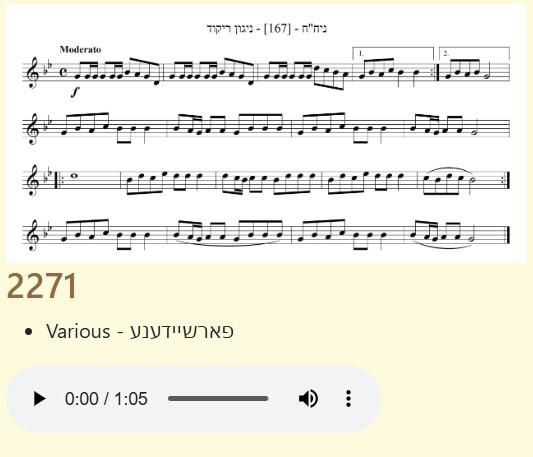
It is an evolving digital archive dedicated to nigunim—devotional chants, often wordless, transmitted across generations of diverse Hasidic communities. As an ongoing research project, the database at this stage focuses on nigunim documented in Eastern Europe. It draws on early printed collections and manuscripts that reflect how these melodies were known, performed, and categorized in their historical contexts. It also includes transcriptions of pre-Holocaust audio recordings of nigunim, available on a joint digital platform developed by the Kyiv Institute for Information Recording and the Vernadsky National Library of Ukraine. These recordings extend and complement the foundational manuscript collection assembled by M. Beregovsky in 1946. Both the nigunim in manuscripts and the audio-based transcriptions are made accessible, allowing visitors to explore Hasidic traditions across media.
Presented through sound, notation, and contextual descriptions, the initiative displays the nigunim as they were shaped by time, place, and communal practice. The database is designed to accommodate expansions and revisions, assigning each individual nigun a stable URL, enabling precise citation and sustained reference. Relationships between variants, melodic families, genres, dynastic affiliations, and musical parameters are explicitly encoded and expressed digitally. This structure allows patterns of transmission, transformation, and classification to emerge dynamically, as the project continues to grow and be refined. The database is designed to be operational on filtered (“kosher”) internet platforms, enabling Hasidic experts worldwide to listen to melodies, compare related versions, and explore their circulation across Hasidic dynasties and ritual contexts. Searching and browsing are available in three languages—Hebrew, Yiddish, and English—and can be carried out by dynasties, performance contexts, titles, personal names, genres, and musical characteristics. Innovative tools allow users to search through humming or whistling, as well as by combining sung and verbal queries.
Conceived as a long-term, iterative scholarly infrastructure, NigunimBimBom combines public participation with research-based oversight. Visitors are invited to contribute their knowledge to the database—such as melodic variants or contextual identifications—through an online form. By foregrounding historical sources while encouraging exploration and participation, it opens Hasidic musical traditions to a broad public as a shared heritage and as a distinctive musical phenomenon.

