The popularity of this song among singers from North Morocco, almost all from Tetuan, is also attested by the seven different recordings documented in the Kol Israel collection. The song briefly refers to the tasks that accompany preparations for Passover, such as systematically cleaning the house of any leftover leaven (guardai lo hametz, lit. “put away the hametz”), changing the daily tableware for the Passover set (y sacai lo pascual, lit. “take out the Passover”), and providing the two basic elements of the Passover ceremony: the wine (of which four cups are consumed during the traditional Seder) and the unleavened bread (matzah, which in Tetuan is referred to as las tortas).
Yosef Gabay was a key representative of Tetuan Jewry, the community from which this song emanates. A decade before Weich-Shahak, Gabay sang the same song to Sephardic song documenter Itzhak Levi, who eventually published it in volume 7 of his Antología de la Liturgia Judeoespañola (Jerusalem, 1965, pp. 172–3). Gabay, however, referred to this song as a children’s ditty that used to be sung at the beginning and at the end of the Passover break. He provided two versions (both one stanza long). The first stanza is identical to the one recorded by Weich-Shahak; the second one is simply its opposite (put away the Passover utensils and bring the leaven out):
Hermana Simha
Pesah ya se fue
guardai lo pascual
sacai lo hamés.
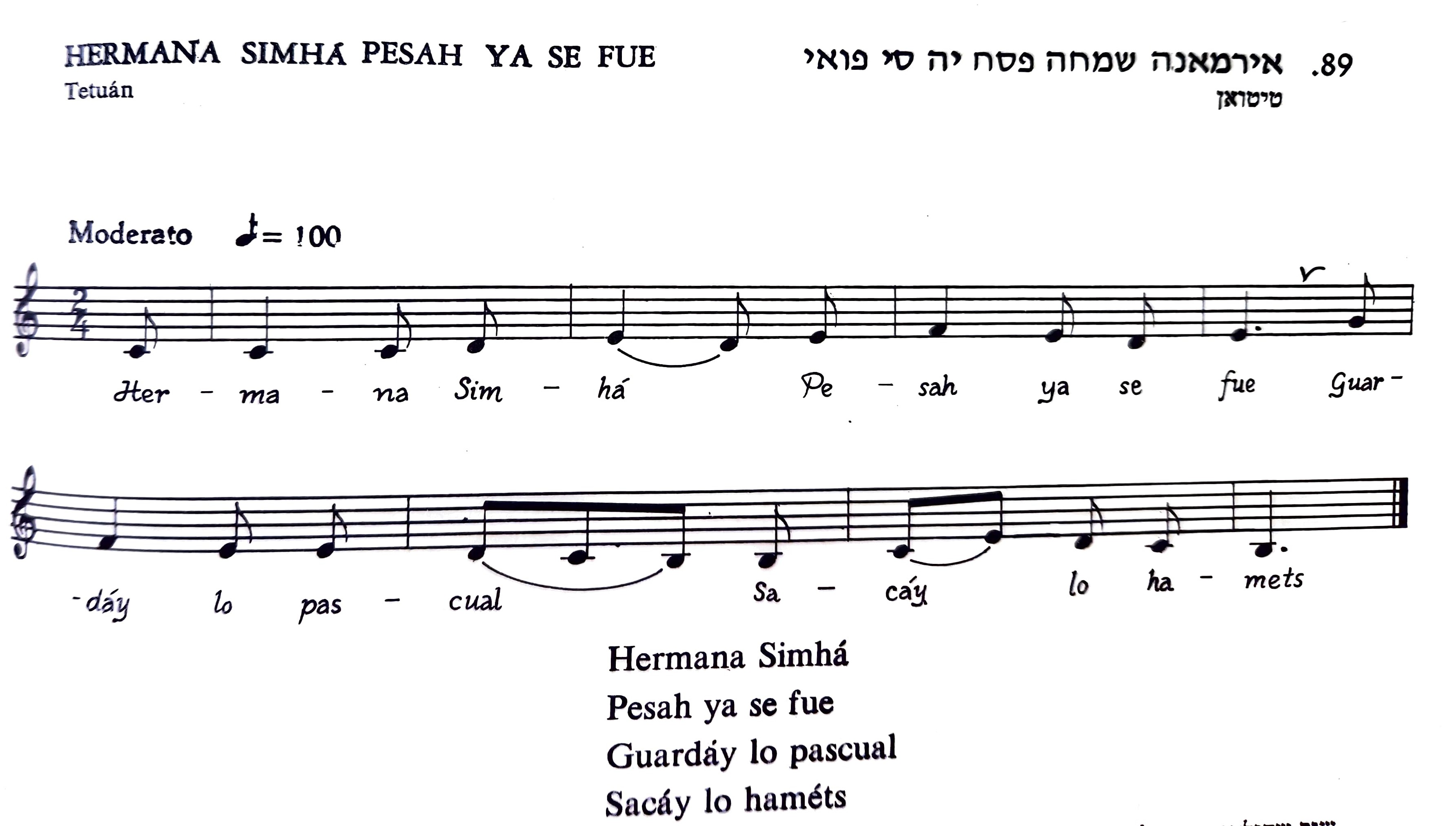
Figure 1. Hermana Simha in Isaac Levi, Antología de la Liturgia Judeoespañola. vol. 7, no. 89, p. 173. The last note is erroneously notated as a B instead of C.
The song was already recorded in the early 1950s by the celebrated Spanish folklorist Arcadio de Larrea Palacín in his Canciones Rituales Hispano-Judías: Celebraciones Familiares de Tránsito y Ciclo Festivo Annual (Madrid: Instituto de Estudios Africanos, 1954, p. 216, T. 103, M. 115). Larrea recorded only one stanza, similar to the second one sung by Yosef and Rahel Gabay to Weich-Shahak:
Hermana Simha
Pesah ya vino
sacáis las tortas
y hazís el vino.

Figure 2. Hermana Simha in Larrea Palacín, Canciones Rituales Hispano-Judías
This ditty is set to a very short melody that closely recalls Western European children’s rhymes. As with all folk creations, this tune offers ample room for improvising new stanzas or for creating a chain of different songs set to the same melody. One such stanza is reported in the Moroccan Jewish internet forum Dafina. The entry in French reads as follows: Your cousin Simita invited us for dinner, and her father, Mr. Levy (96 years of age), who thoroughly enjoyed his wine and also his mahia, started to sing songs of Passover in Haketia [the Judeo-Spanish dialect of North Morocco]:
La hermana Simha,
Pessah yavenu [sic],
compre la torta,
que ba bebhillou.
“Ba bebhillou” refers to a Moroccan Jewish custom performed during the Passover Seder that includes the singing of a verse starting with “bibihlu” (Hebrew for “in haste”). In the first section of the Seder, family members take the Seder plate (or the matzah) and tap it gently on the head of each person present. It functions as a reenactment of the Exodus from Egypt, symbolizing the hasty departure of the Israelites from slavery. The complete verse is “Bibihlu yatzanu mi-misraim, ha lahma anya, bene horin,” and it translates: “In haste we left Egypt; this is the bread of poverty; [now we are] free.” This custom is already recorded in Spain in the 14th century, as noted by Rabbi Itzhak ben Shelomo Alahadev in his commentary on the Haggadah, Pesah Dorot (ed. Yaacov Shmuel Spiegel, Jerusalem, 1980, p. 45): “The custom of Spain is to raise the Seder plate in one’s hand and say, ‘Ha, bread of affliction,’ meaning, this is the bread of poverty that our ancestors ate in Egypt. And they used to circle the plate around the heads of the little ones.” Thus, the last line of this stanza of “Hermana Simha” sung by Mr. Levy translates as “purchase the matzah because the ceremony of ‘bibihlu’ is coming up!”
Finally, who is Hermana Simha (lit. “Sister Joy”)? As is often the case in folk traditions, this may be a generic designation, with obvious gender connotations—namely, that it is the role of the woman to prepare for the Seder. Yet, it may also refer to a specific person.
Clemence Bendelac Levy (1919–2002), a Tangier-born Jewish writer living in Montreal, provides an intriguing clue. In a review of a concert by the then newly established ensemble Gerineldo, which specialized in the Judeo-Spanish song repertoire of Morocco, published in La Voix Sépharade (November–December 1983, p. 38), she writes (in French): “Kelly [Raquel Sultán] Amar [one of Gerineldo’s original members], who on stage, with her hands on her knees, reminds me so much of Hermana Simha, my centenarian neighbor who, with her gaze lost in search of times past, modulated the same melodies brought back from the exile.” (see https://numerique.banq.qc.ca/patrimoine/details/52327/2688761)
Clemence’s neighbor, Hermana Simha, was therefore born around 1883. Could she be the heroine of our ditty? Incidentally, the recording of Hermana Simha by Gerineldo in their first commercial album (Me vaya kappará, 1995) is “guilty” of popularizing this humble and very local Passover song, turning it into an item of the modern global repertoire of Sephardic music.